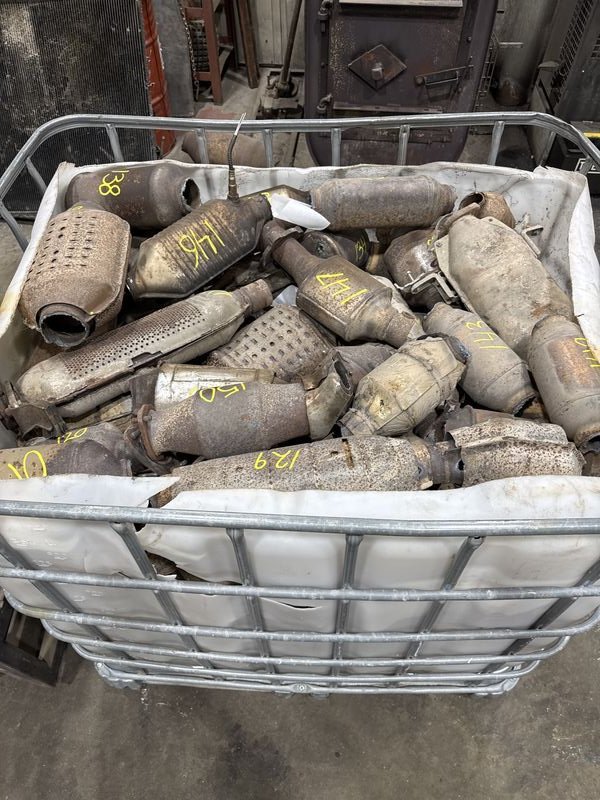
Catalytic converters are worth more than most people realize — and most scrap yards won't explain why. If you've ever pulled a cat off a vehicle and wondered what happens next, this guide breaks it down clearly. Understanding how scrap yards handle catalytic converters and precious metals helps you make smarter decisions, ask better questions, and avoid leaving money on the table.
Why Catalytic Converters Are the Most Valuable Scrap You Might Be Sitting On
A catalytic converter looks like a simple metal canister bolted to your exhaust system. Inside, it's a different story. Each cat contains a ceramic honeycomb substrate coated with platinum group metals (PGMs) — platinum, palladium, and rhodium. These aren't trace amounts. A single cat from a light-duty passenger vehicle can carry anywhere from one to several grams of PGMs, and high-load vehicles like trucks, SUVs, and certain hybrids carry significantly more.
PGM prices are driven by global mining supply, industrial demand, and currency markets — and they move fast. Rhodium alone has historically traded at multiples above gold. That's why a scrap metal buyer near me Hamilton isn't quoting you based on the weight of the steel shell — they're quoting you based on what's inside. The metals recovery process is what sets catalytic converter buying apart from every other scrap transaction.
- Platinum (Pt): Used in diesel converters and older gasoline models
- Palladium (Pd): Dominant in modern gasoline converters
- Rhodium (Rh): Present in smaller amounts but the highest value per gram of the three
If you're in Hamilton or the surrounding Ontario region, the volume of automotive and industrial work in the area means there's consistent demand for cats. Knowing what you have — and how the pricing works — is the first step to getting a fair deal.
How Scrap Yards Actually Price Catalytic Converters
Here's where most sellers get tripped up. Unlike copper or aluminum — where your yard weighs the metal and pays by the pound — catalytic converters are priced by assay value, not by weight alone. The yield of PGMs inside each specific converter type is what determines its market price. Scrap yards use reference databases that cross-match your converter's serial number or part number to historical assay data from smelters and refiners.
That's why serial number visibility matters. When you bring in a cat without a readable serial, you're handing the buyer more pricing power because they can't confirm exactly what's inside. Reputable yards will still make an offer, but documented, identifiable converters give you a stronger negotiating position. Platforms like SMASH help you find the best price for your scrap in Canada by creating competitive pricing environments rather than single-buyer guesswork.
A few factors that influence catalytic converter pricing at the yard level:
- Series and grade: High-grade, mid-grade, and low-grade cats are distinct categories with different PGM loads
- Vehicle origin: Domestic, foreign, and large truck converters are priced differently
- Condition: Cracked or broken substrates reduce yield and affect pricing
- Market timing: PGM spot prices fluctuate daily, sometimes sharply
- Volume: Yards often pay better per unit when you're bringing in multiple cats
The Processing Pipeline: From Your Yard to a Precious Metals Refinery
When you sell a catalytic converter to a scrap yard, the journey isn't over. The yard is typically acting as an aggregator, not the final processor. They hold and sort converters by grade, then ship loads to a specialty processor or directly to a precious metals refinery. The refinery runs a process called smelting and assaying — the converter substrate is destroyed, all metals are extracted, and the exact PGM content is measured.
This is called the toll refining or direct purchase model. In the direct purchase model, the yard buys your cat outright and absorbs the refining risk. In a toll model, you theoretically share in the final assay result — though this is rare for smaller sellers dealing with individual yards. Most residential and small commercial sellers are working in the direct purchase model without realizing it.
What does this mean for you? It means there's a margin built in at every step. The yard buys below expected assay value, the processor charges a refining fee, and the refinery takes its cut. That's the cost of the supply chain. Competition at the buying stage — which is exactly what SMASH is built to create — is the most direct lever you have on the outcome.
Scrap Yard Prices in Hamilton: What to Realistically Expect
Scrap yard prices in Hamilton track closely with North American PGM markets because the metals ultimately get refined and traded globally. That means local price variation between yards is mostly about margin and transparency, not fundamentally different access to market data. The best move is always to get multiple quotes.
Prices fluctuate daily based on spot metal markets. Don't assume last week's quote is still valid. Always ask your yard when they last updated their converter pricing, and whether they're using a live database or periodic updates. A yard using stale data might quote you less than current market — not because they're dishonest, but because their process is slow.
Disclaimer: Scrap metal prices — including catalytic converter pricing — change frequently based on global commodity markets. Always check current rates directly with your buyer before making a decision.
Some practical tips for getting better scrap yard prices in Hamilton on your cats:
- Clean the converter before you bring it in — remove excess pipe and brackets
- Keep the serial number visible and legible
- Call ahead and ask if they use a live pricing database
- Get at least two or three quotes before committing
- Ask specifically whether the price is for the whole unit or substrate only
To find a scrap yard near you in Canada that handles catalytic converters, use a locator that filters by material type — not every yard buys cats, and some that do only take them in volume.
What About Other Precious and Non-Ferrous Metals at the Scrap Yard?
Catalytic converters get the headlines, but scrap yards handle a range of valuable metals that most people overlook. Understanding the broader non-ferrous picture helps you maximize every trip to the yard — and ensures you're not accidentally leaving value behind.
Common high-value non-ferrous materials that scrap yards in Hamilton and across Ontario actively buy include:
- Copper: Wire, pipe, and bus bars — one of the highest-value everyday scrap materials
- Aluminum: Rims, extrusions, sheet, and cast aluminum all have different grades and prices
- Brass: Fittings, valves, and fixtures — often underidentified by sellers
- Stainless steel: Kitchen equipment, industrial pipe, and medical equipment
- Lead: Batteries, wheel weights, and old pipe (handled with specific safety protocols)
A common question that comes up: can you sell a safe for scrap metal? Yes — most safes are steel-bodied, which means they have scrap value, but the value depends on the weight and condition. Some safes also contain composite filler materials or locking mechanisms that may need to be removed. Call ahead and confirm your yard accepts them and ask if any preparation is required. Don't assume a safe is worth the same per pound as clean structural steel.
For broader guidance on what different facilities accept, read Canadian scrap yard guides that break down material types, preparation tips, and what to expect at the scale.
How to Get the Best Scrap Metal Prices — Not Just the First Offer
The single biggest mistake scrap sellers make is accepting the first price they hear. The scrap industry is built on information asymmetry — buyers know more about market pricing than most sellers do, and that gap gets priced into every transaction. The way to close that gap is competition.
Getting multiple offers on your cats, your copper, or any significant load creates real price discovery. That's not just a theory — it's the core mechanic behind auction-style selling. When buyers compete, you learn what the market actually thinks your material is worth. When only one buyer sees your load, you learn what that one buyer wants to pay.
SMASH was built specifically to create that competition for scrap sellers across North America. If you're moving volume — whether it's a load of cats, a bin of copper, or mixed non-ferrous — having vetted buyers bid against each other reveals the actual market price. No subscription, no guesswork. That's a fundamentally different dynamic than a single phone call to a single yard.
If you're an individual seller in Hamilton, start by exploring Hamilton scrap metal services and comparing what local buyers offer. If you're moving material at scale, the auction model is worth understanding before your next sale.
Ready to see what your scrap is actually worth? Locate the closest Canadian scrap yard and get a baseline quote — then use competition to do the rest of the work.
Frequently Asked Questions
Q: How do I know if my catalytic converter is worth selling to a scrap yard near me in Hamilton?
Almost every catalytic converter has some value due to its platinum group metal content. The exact value depends on the converter type, series, condition, and current PGM market prices. Bring it to a yard with a live pricing database, or get multiple quotes to understand where you stand.
Q: Do scrap yards in Hamilton buy catalytic converters off individual sellers, or only from businesses?
Most yards buy from both individual sellers and businesses. However, regulations require valid ID and often vehicle documentation to sell converters — this is standard across Ontario to help combat theft. Have your ID and, where relevant, proof of vehicle ownership ready.
Q: What's the difference between scrap metal prices today and what the yard will actually pay me?
Spot prices you see published online are wholesale refinery-level benchmarks. What a yard pays reflects their operating costs, refining margin, and risk. The gap is normal — competition between buyers narrows it. Always get more than one quote.
Q: Can you sell a safe for scrap metal at a Hamilton yard?
Yes, most safes can be sold for scrap. Steel-bodied safes have solid scrap value by weight. Call ahead to confirm the yard accepts them, ask about any material preparation requirements (some have composite filler that needs removal), and bring documentation if the safe was part of a business or estate.
Q: How does a platform like SMASH help me get better prices than just calling my local scrap yard?
SMASH creates a competitive auction environment where vetted buyers bid on your material. Instead of one buyer naming a price, multiple buyers compete — which reveals actual market value rather than one buyer's preferred margin. It's especially useful for larger loads of cats, copper, and non-ferrous metals.
Selling scrap metal — whether it's a single catalytic converter or a full bin of non-ferrous material — goes better when you understand the process. Hamilton has a strong industrial base and active buyer market. Use that to your advantage by knowing what you have, getting competitive quotes, and choosing yards that price transparently. When you're ready, find a trusted scrap yard near you in Canada at scrap-yard-near-me.ca and take the guesswork out of your next sale.
Stay current on scrap metal market trends and industry updates by following SMASH on LinkedIn — useful whether you're selling one cat or a full truckload.