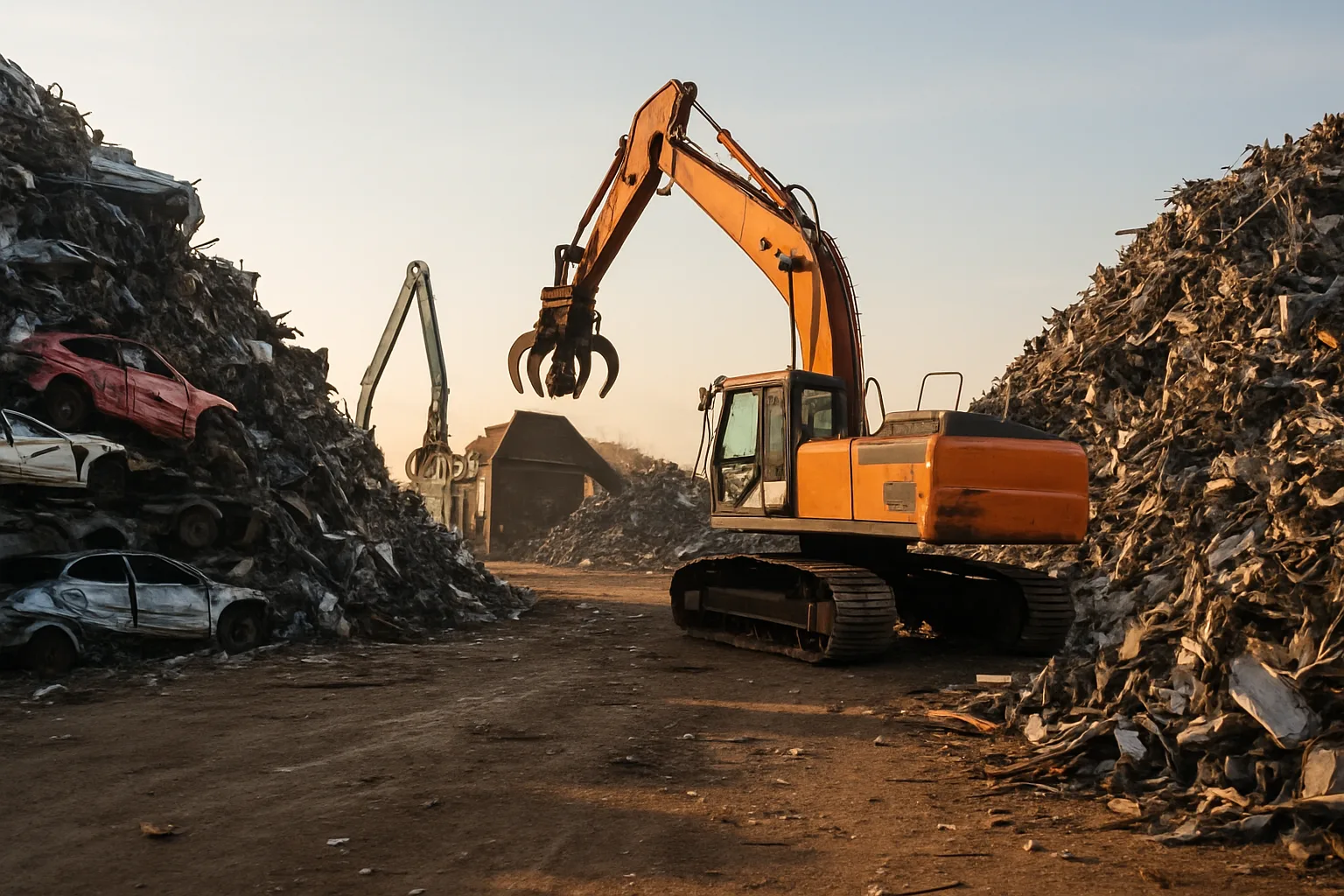
Every year, millions of vehicles reach the end of their road across North America. Most people think of that as a waste problem. Smart recyclers know it's actually a resource problem — and scrap yards are the ones solving it. If you're looking for an auto recycling yard in London, you're already part of something bigger than a cash transaction. You're feeding a system that keeps raw materials in circulation and out of landfills.
This article breaks down how scrap yards power the circular economy, what metals are actually worth pulling from an old vehicle, and how platforms like SMASH are changing the way yards and buyers do business across Canada.
---What the Circular Economy Actually Means for Metal Recycling
The circular economy isn't a buzzword. It's a practical framework: keep materials in use as long as possible, recover maximum value at end-of-life, and eliminate waste. Metal is one of the best materials for this model because it's infinitely recyclable without losing structural integrity. Steel recycled today can become rebar, automotive parts, or appliances tomorrow — no quality loss.
Scrap yards sit at the centre of this loop. They collect end-of-life vehicles, strip usable parts, segregate metals by grade, and feed processed material back into mills and smelters. Without that infrastructure, recyclable metal ends up in landfills. With it, the material stays in the economy. That's not environmental marketing — that's how metal supply chains actually function.
- Steel from car bodies returns to electric arc furnaces as scrap feedstock
- Aluminum from wheels, engine blocks, and radiators gets remelted into new alloys
- Copper from wiring and motors goes back into electrical applications
- Platinum group metals (PGMs) from catalytic converters re-enter the global precious metals market
Every load that moves through an London scrap metal services facility contributes to that loop. It's not charitable — it's a functioning market with real price signals and real demand.
---5 Ways Scrap Yards Support Metal Recycling in Ontario and Beyond
If you've ever wondered why metal recycling in Ontario has grown into a serious industry, the answer starts at the yard level. Here's what scrap yards actually do in the circular economy — beyond just paying you for your car.
-
Material sorting and grading
Scrap isn't one thing. It's dozens of grades, alloys, and contamination levels. Yards invest in shears, balers, shredders, and trained staff to separate material correctly. Proper grading means mills get consistent feedstock. That makes the whole downstream process more efficient. -
Hazardous material handling
Vehicles carry fluids — oil, coolant, brake fluid, refrigerants — that can't enter the waste stream uncontrolled. Licensed auto recyclers drain and contain these fluids before processing. That's not optional. It's a regulatory requirement in Ontario and across Canada, and scrap yards absorb that cost as part of doing business. -
Parts reuse before metals recovery
The best circular economy outcome for a component is reuse, not melting. Auto recyclers pull serviceable parts — engines, transmissions, doors, alternators — before anything gets shredded. That extends the usable life of components and delays the energy cost of remelting. -
Price discovery and market signals
Scrap yards don't set metal prices arbitrarily. They respond to global commodity markets — LME copper, steel futures, PGM spot prices. When yards compete for material through auction platforms, price signals get sharper and sellers get better visibility into real market value. Platforms like SMASH are built around exactly this principle. -
Regional economic contribution
Scrap yards create local employment — drivers, sorters, mechanics, scale operators, office staff. In cities like London, a well-run auto recycling yard generates direct and indirect jobs while keeping material flows local before export.
The Best Scrap Yard in London Isn't Just About Location — It's About Transparency
When people search for the best scrap yard in London, they usually mean the one that pays the most and causes the least hassle. Fair enough. But transparency is what separates a great yard from one that leaves you guessing. Can you sell scrap metal for cash without knowing if you got a fair price? Technically yes. But it's not a great position to be in.
The old model looks like this: you call one yard, they quote a number, you accept or walk away. You have no idea if that number reflects actual market conditions or if another buyer would have paid 20% more. That asymmetry has defined scrap transactions for decades.
The shift happening now — driven in part by platforms like Canada's B2B scrap recycling marketplace — puts more information in sellers' hands. When multiple vetted buyers compete for a load, price discovery actually works. You're not guessing. You're seeing the market.
For individual sellers asking can you sell scrap metal for cash, the answer is yes — and knowing your material's value before you walk into a yard is the single best thing you can do to protect yourself.
---Catalytic Converters: The High-Value Item Most Sellers Underestimate
If you've ever searched sell catalytic converters online, you already know cats are a different category. A single catalytic converter from a luxury vehicle or a diesel truck can contain platinum, palladium, and rhodium — precious metals with significant market value that fluctuate daily based on global supply and demand.
This is exactly where documentation and transparency matter most. Catalytic converters have been a target for theft across Ontario and the rest of Canada, which means legitimate recyclers now require verification — VIN numbers, proof of ownership, serial number tracking — before purchasing. That's not bureaucracy. It's how the industry keeps its supply chain clean.
Before you find a scrap yard near you in Canada to drop off your cats, do your homework:
- Know the make, model, and year the converter came from
- Have proof of ownership or vehicle title available
- Get more than one quote — PGM prices vary significantly between buyers
- Ask whether the yard uses a serial tracking system (a sign of a professional operation)
The yards using proper documentation tools and photo verification aren't making your life harder — they're building a defensible paper trail that protects you and them. SMASH's platform includes serial tracking and photo documentation for exactly this reason.
---Is There a Scrap Yard Near Me Open Today? What to Know Before You Go
Searching scrap yard near me open today is one of the most common queries in this space — and one of the most frustrating when the information online is outdated or wrong. Hours change seasonally. Some yards close on Sundays. Some accept vehicles by appointment only. Showing up with a load of non-ferrous on a statutory holiday with no heads-up is a wasted trip.
Before you load up and head out, here's what to confirm:
- Current operating hours — call ahead or check the yard's website for real-time information
- Material acceptance — not all yards accept all materials; some specialize in auto recycling, others in industrial scrap
- Scale requirements — larger loads may require a weigh ticket or pre-arranged drop-off
- ID requirements — Ontario regulations require identification for certain metal transactions, especially catalytic converters and copper
- Pricing format — some yards pay on the spot, others process and pay by cheque or EFT within a few business days
To locate the closest Canadian scrap yard with accurate, up-to-date listings, use a dedicated directory rather than relying on a general search engine result that may not reflect current hours or services.
For B2B sellers — yards, dismantlers, industrial operators — the process is different. Higher volumes mean more leverage, more complexity, and more reasons to use a structured auction process rather than a phone call to one buyer. That's where SMASH comes in. Read Canadian scrap yard guides to understand how the buying and selling process works at different scales.
---How SMASH Connects Sellers to Real Buyers Across Canada
SMASH is a B2B scrap metal auction platform built for yards and buyers who are tired of the single-call, take-it-or-leave-it pricing model. The platform brings vetted buyers to the table, runs a competitive auction process, and handles documentation — BOLs, packing lists, auto-invoicing — so sellers aren't chasing paperwork after the load ships.
For auto recycling yards in London and across Ontario, that means more than just a better price on a single load. It means a repeatable process with real market data. Competition reveals price. Documentation builds trust. Vetted buyers mean you're not dealing with fly-by-night operators who disappear after the truck leaves.
No subscription fees. SMASH only makes money when a transaction closes — which means the incentive is always to get the seller the best outcome, not to rack up monthly charges regardless of results. If you're a yard operator or industrial seller ready to move material differently, email jeff@smashscrap.com directly.
The scrap industry runs on trust and price. SMASH is built to deliver both.
---If you're ready to find a yard, sell a vehicle, or move a load of non-ferrous, start by finding the right partner. The circular economy works because every link in the chain does its job — and your job as a seller is to find a yard that takes that seriously. Check scrap-yard-near-me.ca to find a trusted scrap yard near you in Canada, with listings across Ontario and beyond.
Prices for scrap metal — including catalytic converters, copper, aluminum, and steel — fluctuate based on global commodity markets. Always confirm current rates with your yard before dropping off material.
---Frequently Asked Questions
Q: What is an auto recycling yard and how is it different from a regular scrap yard?
An auto recycling yard specializes in end-of-life vehicles — draining fluids, harvesting usable parts, and processing metals like steel and aluminum. A general scrap yard may accept a wider range of metals but may not have the equipment or licensing to handle full vehicles. In London, Ontario, some facilities do both.
Q: Can you sell scrap metal for cash in London, Ontario?
Yes. Many scrap yards in London accept walk-in sellers and pay on the spot for metals like copper, aluminum, and steel. However, regulations in Ontario require identification for certain transactions — particularly for catalytic converters and copper wire — so bring valid ID and proof of ownership where applicable.
Q: How do I know if I'm getting a fair price at a scrap yard near me?
Research current commodity prices before you go. Copper, aluminum, and steel all have publicly tracked market prices. Getting quotes from more than one buyer is the single most effective way to benchmark what you're being offered. Platforms that use competitive auctions, like SMASH, exist specifically to solve this problem for higher-volume sellers.
Q: What do I need to bring when selling a catalytic converter in Ontario?
You'll typically need a valid government-issued ID, the VIN number of the vehicle the converter came from, and proof of ownership (vehicle title or registration). Ontario's regulations around catalytic converter sales are intended to combat theft, and legitimate yards will require this documentation as standard practice.
Q: Is there a scrap yard near me open today in London?
Hours vary by yard and season. Before driving in with a load, call ahead or check the yard's website to confirm they're open and accepting your material type. The directory at scrap-yard-near-me.ca lists yards across Canada, including London, Ontario, with service and contact details.
---Stay current on scrap metal market trends and industry news — follow SMASH on LinkedIn for regular updates from across the North American recycling market.